Tuesday, April 21, 2015

What you know to be useful, or what you believe to be beautiful

I'm reading a book about decluttering at the moment: It's All Too Much: Living a Richer Life with Less Stuff, by Peter Walsh.  I'm only a few chapters in, and I'm finding it a bit repetitive, to be honest.  Much like an American TV show, it seems to be written on the basis that you can't quite remember what was said ten minutes ago, so repeating it can't hurt none...  But the advice isn't bad.

Yes, once again I'm looking at my surrounds and thinking "why do I have all this stuff?"

Regular readers may remember my previous daydreams about moving to a yurt and only owning whatever I need that could fit comfortably within that circular, tent-like abode.  Of course, I'm still completely surrounded by things and am no-where near ready for a yurt-ish existence.

Walsh frequently quotes William Morris's edict that you should "have nothing in your houses that you do not know to be useful, or believe to be beautiful," which I think is a lovely way to think about decluttering.

For one thing, it gives me a good justification to keep my favourite toys - I believe them to be beautiful.  On the other hand, it also gives me a good set of criteria to use to weigh up the merits of everything else in my house:
  • Is this useful (Y/N)?
  • Is this beautiful (Y/N)?
  • Is this awesome (Y/N)?
Okay, the last option wasn't part of the original equation, but let's be honest - anything that makes you think "this is totally awesome!" gets a place in your life even if it's hideous and pointless.

I've been thinking a little about weeding lately - in a library context.  I'm on a newly formed "space force", which is keeping track of the use of the space in the building and thinking deep thoughts about what needs to be moved around.

One of the things we're doing is looking at specific, discrete collections and thinking about how the space in those areas are being used (like the Reference Collection, the Curriculum Collection and the Scores Collection).

I know Walsh's book is supposed to be used to help you declutter your house, but I'm starting to wonder what would happen if we applied it to our library.

Walsh advises people to start the decluttering process by completely ignoring the clutter, and instead thinking about a core question:  "What is your ideal life?"

Then, you need to think about each room in terms of: "In my ideal life, what would this room be for?  What would it do for me?" and then regard everything that is in the room with that ideal living space in mind.

That sounds like an interesting way to approach a special collection that has been kicking around long enough to get decidedly unwieldy:

"In my ideal library, what is this collection for?  What would it do for my users/patrons?  What belongs in that ideal space?  What would it look like?"

Then, with the ideal as the goal, reconsider everything in that space (including the shelving) with those core criteria:

Is it useful/beautiful/awesome?

Do we have the guts to do it?


Saturday, March 21, 2015

Free Voluntary Reading: How not to do it

When I was in Germany a couple of years ago, I bought a German translation of Agatha Christie's A Death in the Library (Die Tote in der Bibliothek).

I did this as part of a personal experiment in Free Voluntary Reading (FVR - sometimes also known as Voluntary Free Reading, or VFR, but only by people who aren't into brand names).

The core idea behind FVR is that you are more likely to persevere with reading in a foreign language if you are reading something you actually enjoy, and which is interesting enough to keep you going (because you want to know what happens next or see how it ends).

Textbook reading activities are boring.  Trashy teenage romance novels, on the other hand, are fun and engaging.  So get your language learners to abandon their carefully selected passages from Goethe and go straight for the trashy fun stuff.

Agatha Christie novels are fun.  Murder mysteries are designed to keep you guessing.  It seemed perfect.

I wilfully ignored another element of the FVR ethos, however, which was to choose books that aren't too difficult.  If you want to improve reading fluency, you pick books that are within your current reading level.  If you want to improve your vocabulary, you pick books that are mostly within your current reading level - keep it close to what you can comfortably do, with a bit of stretch.

Now, I had successfully ignored this element in the past, when I found a copy of Ursula Wölfel's Julius, oder die wahre Geschichte vom Ziegenbock, der die Leute solange ärgerte, bis alle ihn haben wollten - a hilarious children's book about a couple of sparring communities who had to share an adopted goat.

Sure, I only understood half of what I was reading - but I got the gist, I enjoyed the book, and I understood enough to make it fun rather than confounding.

However, I didn't count on a crime novel written for adults being more textually dense than a comedic children's book.  I didn't get past the first couple of paragraphs, and left it on a shelf for my German abilities to catch up (something that doesn't currently look likely).

Then, last year, I found a copy of the book (in English) in audio format in my library.  I'm quite fond of crime audiobooks, and I thought I might be more capable of making my way through the German version if I was already familiar with the plot and characters.

Then, I had a flash of inspiration - I stopped the CD at the end of the second last chapter.  I took it out of my CD player, and returned it to the library.  I had listened to the entire book, except the last chapter - to find out how the book had ended, I would read the German version.

Brilliant, isn't it?

I had just enough motivation to start reading the first couple of chapters of the book - and just enough knowledge to begin making a decent fist of it...

And then, for one reason or another, I didn't have time to keep going.  And then my German classes didn't work out quite as I had planned, and my German actually regressed rather than improved...

And now it's a year later.

Over a year later.

It turns out that I'm actually not in the least bit frustrated by never finding out whodunnit.  Oh, I'm sure I'll get around to discovering the end of that story eventually, but I don't feel a great need to complete that narrative in order to feel at peace in my life.

Meanwhile, the book is still sitting on my shelf.  Seemingly further away from me than ever.

Thursday, February 26, 2015

Get off the floor

I've recently had an operation, and my mobility has been less than stellar.  I'm getting better everyday, but I still have difficulty doing anything at floor level.

I can finally reach down to the floor to pick something up (previously, once it hit the floor it was lost to me), but I can't really spend any quality time down there.

This has made me realise how important it is for libraries to get their collections off the floor.

In the last few days I have found myself in two different libraries where the book I wanted was on the bottom shelf, and the bottom shelf was barely inches higher than the floor.

As I had great difficulty bending down long enough to read the titles of the books to find what I wanted, I found this experience to be particularly unpleasant.

It was also disheartening, as the minute I saw the section I wanted was on the bottom shelf I knew it would be difficult for me.  Both times I seriously considered giving up on the books I wanted rather than putting myself through that kind of discomfort.

In both cases, the effort I had to expend to try to search the shelves at floor height was too much.  I ended up leaving earlier than I had originally intended, simply because the collection itself had worn me out.

Now, when I mentioned this to one of my colleges, her first question was "why didn't you just ask one of the librarians to get it for you?"

The answer is simple and twofold:  a) I'm stubborn, and b) I don't feel like asking for help every single time I can't reach something that looks like it should be within reach.

Asking for help for such simple little things is also unpleasant.

Now, I'm currently having issues with floor-height shelving because I'm recovering from an operation, but when you think about it there are a lot of people with long-term mobility issues (anything from a dodgy back or knee to being in a wheelchair) who would naturally have trouble bending down for long periods of time to look for things.

So, I'd really like to take this opportunity to encourage any library who still has their bottom shelves at floor height to get the collection off the floor.

It's not as trivial as you think, if it is causing your clients pain, discomfort and dismay.

Saturday, November 15, 2014

Predictive text

I have a new toy for work. It's a tablet, which comes with a word processing application.  I'm writing this post on the device while attending a meeting.

So far, I have been able to write several sentences using the thing without having to type more than three or four letters for any given word. It amazes me how often I am able to make do without needing to write anything at all.  The predictive text isn't just predicting the word I've started to write, but also the word I'm likely to want next.

I don't know by what magic the device is doing this, but I suspect it has something to do with corpus linguistics.

Corpus linguistics  is a strange and slightly disturbing branch of linguistics that involves dumping entire texts into a database in order to find and analyze patterns.

One of the most interesting things to come out of corpus linguistics is the increased understanding of collocation (and, yes, the device has also been predicting the words corpus, linguistics and collocation).

Collocation looks at words that turn up next to each other (like "next to" and "each other"). We generate a lot of patterns when we speak and write, and certain words tend to follow each other over and over again (like "over and over again").

I think the predictive text used by this device has quite a lot of collocation built in.

When I type "next", the device instantly offers me "to", and when I  type "each", I  get "other" - I don't even have to type the first letter for these words, they are just automatically generated by the device.

I am making quite a lot of sentences by simply touching the next word offered to me.

In fact the next sentence is going to be written using nothing except the options given to me by the program:

I have been in contact with the new version of the world, but I think I can say that I have been able to get some good ideas about what we want to know.

I didn't type a single word for that.  Sure, it didn't exactly make sense, but that's beside the point.

Collocation.  It just might change the way I write in the future.


More on that later. 

Friday, October 31, 2014

Raise your girls to be strong. Teach your women to swim.

I was checking someone's references today when one of the articles he cited caught my attention and I had to read it for myself.

The article, by Joni Seager,1 notes the fact that most natural disasters have a racial and gender imbalance in terms of the survivors.  In countries like America, black people are likely to be hit hardest by natural disasters.  All over the world, however, women are less likely to survive.

In some cases, the death rates for women have been as high as five times those of men.

People studying this phenomenon have noted that our prevailing stereotypes encourage women and girls to be weak and inactive.  As a result, they aren't strong enough to hold onto the trees.  They are less likely to know how to swim.

Additionally, they're likely to stick around to find and rescue the children, but they aren't strong enough to actually hold on to everyone who needs saving.

By continuing to foster an idea of femininity that doesn't include being physically strong and active, we are literally putting our women and girls in danger.

Let's try making the assumption that "strong enough to survive" is a trait both sexes should share.


  1. Seager J. Noticing gender (or not) in disasters. Geoforum. 2006;37(1):2-3. doi:10.1016/j.geoforum.2005.10.004


Thursday, October 9, 2014

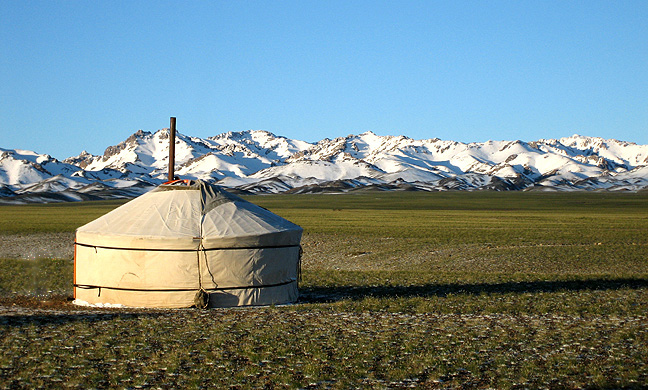
The Yurt Game

And the word of the day is:  Yurt.
GurvgerCC BY-SA 3.0

I was chatting to one of my colleagues earlier about being in a "decluttering" phase (yes, I know how futile that is when you happen to be a very cluttered person), and I said I was trying to prioritise what I would want to keep if I had to move into a yurt.

She had never heard of a yurt before, so we spent several minutes looking up pictures of various yurts from the traditional tents of nomadic Asian tribes people to the "glamping" monstrosities of today.

There's a game I've been playing as I've been trying to sort out my bookshelves, and I invite you to play a similar game in your homes:

Say you had to move from your house into a yurt.  You can make up your own reason for why, that's not the important thing.

The important thing is that your yurt doesn't have space for your bookshelves.  You have stubbornly insisted on having at least one book shelf, but that's all you get.  One.  Singular.

If you are anything like me, you probably have several bookcases scattered around your house, each at various levels of fullness.  Imagine you have to reconcile all of those books to just one shelf.

I mean every book - fiction, how-to manuals, cook books, reference books... the lot.  Whatever you can fit on one shelf of one of your current bookcase is what you get to keep.

Now, before you start thinking about your answer to this question, remember that libraries exist.  And you probably have friends with similar reading tastes.  The vast majority of books currently taking up space in your house could probably be borrowed if you really wanted to see them again.

So, what goes on the shelf?

Books that are irreplaceable.  Books where that specific copy has some deep meaning to you.  Books you use all the time or consult frequently.  Books that are so close to your heart that you can't imagine any home of yours not having this book in it...

Tell me about a no-brainer - a book you know would definitely be on that shelf.  You can put it in the comments for this post, or submit it to your social media platform of choice with the tag #yurtbooks.

It will be interesting to see what matters to you.

Friday, October 3, 2014

If Agatha Raisin went to Lochdubh...

There are many different types of crime novels, but when it comes to series of crime novels there seems to be two overarching archetypes.

One is the series that involve a detective who actually has a reason to go around solving crimes.  This person is a police officer, a sheriff, a DCI, a Kommisar... whatever the local law enforcement happens to be.  He or she is paid to find murderers, so it makes sense that they would be asking awkward questions in pursuit of a killer.

This person is usually stationed at a particular place.  Quite often this is a country town - no doubt because country towns offer a nice range of eccentric recurring characters for the author to draw on.  However, this does mean that a lot of murders occur in that country down.

Quite a lot.  An inordinate amount of murders.  So many, that these little country towns seem to be vying for the role of "crime capital of the country".

It's a wonder the eccentric locals don't all leave to find some place less murdery.  And those stay would be forgiven for getting a bit blase about it all:

"There's been a murder!"
"Oh?  Well, I suppose it has been several weeks since the last one..."

The second main archetype for crime series involves the amateur detective.  This is the person who has no good reason to go around solving crimes, they just happen to be particularly clever and always in the right place at the right time.

It doesn't seem to matter where this person goes, death is sure to follow.  Thankfully, these people are usually quite interested in crime solving and enjoy the process of finding murderers, or they would surely find the amount of death rather disturbing.

"Thank you for inviting me to your birthday party - whoops, there's a murder."
"I'm just in town for a few days visiting my - whoops, there's a murder."
"I saw this place in a holiday brochure and thought it looked like a nice - whoops, there's a murder."
"I'm afraid I can't come to your wedding on that mysterious island, even though it sounds lovely, as I want everyone to make it out alive."

I can't help but wonder what would happen if one of these murder magnets found themselves visiting one of these crime capitals.  If Miss Marple wetn to Midsomer to visit a friend, would there be a mass killing?  Would multiple people die in multiple locations under multiple sets of mysterious circumstances which may or may not be connected?

If Agatha Raisin went to Lochdubh, would anyone make it out alive?

Newest post

The logistics of it all

So I've fallen down a Logistics rabbit hole. It all started when I was looking at the jobs available at the Antarctic Program, who don...

Popular posts