Thursday, February 7, 2019

Bad Buddhist is the wrong book.


I try to make a point of buying new books at a physical bookshop on a semi-regular basis, just for the heck of it. Bookshops never have anything I need. I live in a library – sorry, work! I work in a library. I don’t live here, I just never leave. Anyway, I work in a library, and I occasionally visit the local public library as well, so 90% of my book “needs” can be covered for free. That last 10% is too old, weird or technical to be sold in a “real” bookshop, so I make most of my serious book purchases online.

Yet I don’t want to live in a world without a local bookshop. I want there to be shops outside of airports where people can go and browse books and buy them in person. So, even though I’m not a huge fan of wasting money on crap I don’t need, I buy new books at full price for the heck of it. I wander in, find something that strikes my fancy, and buy it. I often try to pick an author I haven’t read before or a genre I don’t usually read (but I have to admit that most of the time it’s holiday reading fare).

In my most recent excursion, I found a book by Meshel Laurie called Bad Buddhist. I’m familiar with Meshel Laurie from television (I still miss her early 2000s stand-up show), but I don’t read any of the magazines she writes for, so I’ve never read her work. Plus, this is (or appeared to be) the type of book I’ve been enjoying from the public library of late (personal reflections on Buddhism, perhaps from a woman’s perspective), so it seemed like a good choice.

This book is wrong. That’s the only way I can describe it. On a fundamental, publication level, as a book, it’s wrong. It has the wrong title, the wrong tagline, the wrong cover image, the wrong jacket blurb and the wrong structure – and it’s displayed in the wrong part of the bookshop.

I found this book in the Religion and Spirituality section of the bookshop (sitting next to Meshel’s earlier book, Buddhism for theUnbelievably Busy*). It’s called Bad Buddhist, the tagline promises “speed bumps and detours on the path to enlightenment” and features a picture of Meshel giving a Namaste-style salute.** All of these things, combined with the titles of the chapters and the blurb on the back, suggest it’s going to be in a genre I like to think of as “humorous anecdotes with faith-based reflections”. The genre probably has a different, much better name, but I’m an academic librarian so I’m not completely down with the terminology – I am, however, someone who has read several books that fit within this genre over the years, and I know what to expect.

Granted, I’m not familiar with this genre from a Buddhist perspective. Catholic, Anglican, or Presbyterian, on the other hand? Totally. Thanks to my mother’s and aunt’s bookshelves, I grew up with that stuff. Books like My Cope Runneth Over and The Sacred Diary of Adrian Plass, Aged 37 3/4*** were in my space from an early age. Even if this book wasn’t necessarily in that genre, the next logical expectation would be what I mentioned above: personal reflections on Buddhism from a woman’s perspective. Either of which I was okay with – this is what I imagined I had signed up for when I bought it.

This book was neither of those things. It was an anthology of articles she had written for various publications that occasionally (very, very occasionally) mentioned something Buddhist. Most of the time, though, this was a collection of a comedian’s autobiographical writing, and it just so happened that the comedian was a practising Buddhist. I guess you'd say the book was about a Buddhist, but I was expecting more mentions of Buddhism within the book.

I also felt that, not only was the book itself not what the outside of the book implied it would be, but it wasn’t structured well for what it was. I don’t mind a good anthology, but I like to know that’s what I’m reading. An anthology doesn’t hang together the same way a book written as a single piece of writing does, so without knowing that I was reading pieces written for several different publications over the course of at least six years, I found it uneven and disjointed – not to mention oddly lacking much by way of “Buddhist” content.

At some point I flicked to the back of the book and noticed the “acknowledgements” actually solved the puzzle – it told me that “some” of the pieces had been published previously in a number of different publications (and by "some", aparently they meant over 80% of the book). Suddenly, the book actually made sense.

If, like a normal anthology, there had been an introduction where Meshel let us know we were surfing across several years’ worth of work, everything would have fit together nicely. If, as often happens in anthologies, we had some information at the start of every story that put it in context (like the date it was written), that would have made this a grand little trip through a jam-packed time in a Buddhist comedian’s life. If this book had been called Whatever Floats Your Boat**** and the cover picture was Meshel walking along a beach, then it would have been suitably neutral in its advertising of “Buddhist” content, and the fact that there wasn’t much of it wouldn’t be confusing. And if it had been shelved with the other autobiographical books written by comedians, then everything would make perfect sense and everyone would know what they were buying.

It wasn’t the book I thought I was buying. It’s not the book that was advertised. It’s not a bad book, it’s just wrong – and it didn’t have to be. A few simple changes would have made it more honestly what it is. Granted the book it actually is is not the book I wanted to read at that point in time, but that’s beside the point.


*I probably should have bought this book first, but I have an irrational distrust of books with “For Busy People” in the title. I should get over that, I suppose. Besides, it’s probably not what I think it is.

**Meshel has the same photo on the cover of most of her books published through Blank Inc. The front cover. Someone needs to quietly take her or her publisher aside and remind whoever is responsible for the cover design that the front of a book is not the place for the author bio pic. 

***It occurred to me, when I was thinking about this, that back when I read that book I thought 37 3/4 was definitely middle aged (of not heading towards old), and now I’m older than Adrian was. I should re-read it to see if he seems less like an old fart now.

****Naming an anthology after one of the stories inside it is fairly common practice.

Friday, January 25, 2019

On Magical Tidying, Or: Molly Vickers Wets Her Nickers


I'm currently reading Marie Kondo's book (which you may have heard of) about tidying up, largely because I recently bought a Kindle and I was looking for a few different things to load up before going on holidays.

Momentary digression to talk about ebook readers: 

I bought a Kindle partly to try this whole ebook reader thingy, and partly because I noticed a few books I was interested in reading were way cheaper and easier to obtain by Kindle than by traditional means (i.e., ordering it from the other side of the planet). However, I just remembered one of the reasons why I hadn't bought an ebook reader ages ago is the fact that I can't lend the books or give them away after reading them, and that sucks.

Back to rambling on about Kondo's book: 

So, this woman clearly has deep seated issues and probably should have had some sort of intervention when she was a child. She talks about how much "freedom" she had as a middle child, whose parents were busy looking after the youngest and whose brother completely ignored her to play video games, and how she used that freedom to develop an obsession for housewife magazines and form a life-long passion for tidying up - and yet spent most of her childhood and youth feeling that no matter how much she tidied, her room never seemed tidy enough.

Essentially, she's a person who was raised by Home Beautiful magazines and has developed a tidying mania as a way to exert some control over her life. And yet she's made a bucket load of money from her *ahem* "passion", so while she might be insane, she's certainly not crazy.

And that's how I'd sum up her book really – insane, but not completely crazy. Reading her book is an interesting rollercoaster that goes a little something like this:

"This woman is nuts! Oh, actually, that's a really interesting idea. Nope, this is just loony. Oh, I can see how that would work. I should give that ago... aaand it just went seriously weird again."

For example, she suggests storing things vertically rather than in piles, because you can easily see what you have and how much you are accumulating. Interesting idea, and I could see how it would work. She suggests storing your laptop like it's an actual book – I hadn't thought of that before but I like it. And then she tells us she loves carrots to pieces and she stores them vertically in her fridge, keeping them in cup holders so they can stay upright.

Why? Why would you go out of your way to store carrots vertically? Why would you tell thousands of people that you store your carrots vertically? Surely this sort of thing is between you and your carrots?

I'm also concerned that there doesn't appear to be any kind of charity shop in Japan, because she spends a lot of time telling you to throw out clothes and books that don't "spark joy", but never once suggests donating items that are still in good condition to charity. It's straight into the bin bag, if you please. This seems strange, because surely it would be easier to let go of something that's "still good" if you knew someone else might appreciate it more than you?

Speaking of books, she clearly doesn't have the soul of a librarian or archivist. That's okay, not everyone does, but some people do and that's going to play havoc with her "if it doesn't spark joy, toss it out" approach to weeding your book collection or paperwork.

I used to be the kind of person who had to keep every book I've ever owned. When I moved to Tasmania, I took boxes and boxes of books with me – and left more at my family home because I couldn't part with them. And then I lumped them all back when I moved back to Queensland.

I'm getting better at this, and over the years I've weeded a lot of my collection. I'm planning another big cull shortly, where I'll be saying goodbye to quite a number of books that used to mean something to me, but don't belong to the person I am today.

We change a lot over the years, but we keep hold of things for older versions of ourselves because they meant something to us, once. But the truth is, we need to let go of what once mattered to us in order to have space in our lives for new things – or for nothing. Sometimes we need to simply take a break from having things and have a bit of free space for a while.

And yet I know there is one book I'll probably be keeping even though it doesn't "spark joy" and doesn't mean anything to me any more. I've tried to get rid of that book through several successive culls, but I keep fishing it out of the pile and putting it back in my bookcase.

It's called Voices: An Anthology of Poetry and Pictures, edited by Geoffrey Summerfield, and every time I look at it I wonder why I've kept it all these years. And then I remember. I've kept it because there's a poem in that book called "Child's Bouncing Song" written by Tony Connor.

This poem starts with the line "Molly Vickers wets her nickers" and the poem is burned into my brain for reasons I can't explain (we all have our childhood obsessions, mine was poetry – sadly I haven't worked out how to make a fortune out of that, yet). However, I keep stuffing up the two stanzas before the last one. I don't know why. All I know is, every few years or so I'll start reciting that poem in a moment of absent mindedness, and then I'll get to the point where I can't remember if the next line is "High and low and/ to and fro and/ down the street and up the hill" or "Mister, mister,/ Shirley's sister/ won a prize at Blackpool prom."

It will drive me nuts, until I find that blasted book and remind myself how the last half of that poem goes. So while the book doesn't "spark joy", and I'd happily part with it otherwise, I can't get rid of it.

Now, I know what you're thinking: "just photocopy that poem and keep it somewhere". Nice idea, but unfortunately my brain is now broken. Once upon a time I could "accidentally" memorise sections of poetry, and deliberately memorise passages the length of entire chapters. I can't do that any more – my brain elasticity has gone and lost its rebound. I can't remember where I move things to. I try to move them to a more logical place, but I may as well move them directly into a black hole.

So, maybe Konmari's method might actually work for that. A) have next to nothing in the first place, b) put everything in the same category together, so that you just need to go to the place where everything is and look for the scant few things that you still have.

Or, maybe I just need to leave Molly Vickers to dry off somewhere, and decide that I'm okay with never remembering the order of those two stanzas.

Wednesday, January 2, 2019

Book Reflection: Another Book About Bears.


It just so happens, when you’ve set yourself a mini-challenge of writing book reviews/reflections about books with bears in them, that you end up spending a lot of time talking about children’s books. Bears are very popular animals for children’s books, and they slowly peter out by the time you get to books for older readers, young adults or old adults.

It’s like that meme that was doing the rounds on the Internet a little while ago – when you’re a child people ask you what your favourite dinosaur is, but when you grow up they stop asking, like they don’t even care any more. For the record, I’m fond of the elasmosaurus – although technically the underwater critters aren’t dinosaurs, they’re marine reptiles. I don’t know why.

Anyway, the point is that kids books are rife with bears. And this is something that the Buntings point out (to great effect) in Another Book About Bears. The book begins with a typical story-book set up, “once upon a time there was a bear” sort of thing, but the bear in the book almost immediately interrupts the story to complain about how much work bears have to do because they’re in so many darn stories. They’d love to take a nap or eat dinner, but no – someone wants to read another book about bears, so they have to drop what they’re doing and “perform” the story.

Now, I’d really love to read the text behind the bear as he’s* interrupting said story.  There’s something about an Esquilax and a horse with the something of a rabbit and the body of something else. Anyhoo, that’s beside the point, as the rest of the book focuses on the bear and his fellow ursines trying to get out of being in another book by recommending a litany of other animals to replace them.

The book made me chuckle the whole way through – no problem engaging my inner four-year-old with this one.

It also put me in mind of the Thursday Next series by Jasper Fforde. In that series, characters in books have a life to live behind the scenes, but have to perform the story every time someone reads it – much like the bears in this book. It’s an interesting idea, and it’s interesting to encounter it again here.

Jasper Fforde, incidentally, wrote a book about bears that wasn’t a children’s book, and I’ll be looking at that little gem at some point in the future.

In the meantime, if you get the chance, do make sure you read Another Book About Bears. You’ll be glad you did.


*Have you ever notice that most of the books about bears where there is one central bear in the story, the bear is a “he”? I find that interesting, and if anyone can think of any books featuring an ursine central character who is a “she”, I’d very much like to hear about it.

Sunday, December 23, 2018

Book Reflection: Ojibway Heritage


Now, when I said my "books with bears" thing was going to be "semi-regular", I did, of course, mean "actually quite random".

Nevertheless, I have one for you today:

Sharon read Ojibway Heritage, by Basil Johnston.

Should you ask me to recite the first chapter of The Song of Hiawatha, I probably could. Not as well as I used to be able to, back when I was rehearsing it regularly for a Speech exam (yes, I’m one of those kids), but I’d probably get most of it out. I occasionally burst into sections of it for no apparent reason anyway (although most people just think I’m insane, not reciting a particular poem). And I have to admit that the trochaic tetrameter comes to me a little too naturally.

In a way I guess you could say
That this rhythm almost haunts me
But it is a happy haunting -
Happy for it keeps me busy.
Any time I need to churn out
Verses for a rhyme or reason
This will rise up, deep within me
And produce a likely poem.

I love the way the lines don’t have to rhyme to produce a properly poem-y poem – although sometimes I feel like being a smart-arse and trying to get a rhyme scheme in there, too.

So, why am I waffling on about The Song of Hiawatha? Because I recently read Basil Johnston’s Ojibway Heritage – I managed to shoe-horn it into my library’s Reading Challenge as being set in a country I’ve never been to. It fits into that category three times over. I’ve never been to the Ojibway Countries, and I’ve never been to Canada or the USA, which are currently sharing the Ojibway Countries. It also has bears in it, although I didn’t mention that for the review I wrote for my work blog.

As Johnston points out, the Ojibway believe that bears symbolise strength and courage (which is actually one of the reasons why I have a bear tattoo), they offer wisdom and guidance during quests and ceremonies, and they make good eating if you can kill one before it kills you. The Ojibway have an interesting relationship with animals, as they both revere them and revere the hunting of them. The idea is to do it respectfully, and thank the animal for its (somewhat involuntary) sacrifice. Actually, their attitude towards omnivorism is pretty good – live a good and noble life, and do as much good as you can in your life, to justify the lives lost to feed you.

Johnston’s book (a mixture of explanatory text, poetry and stories) elucidates the Ojibway spiritual take on the world – their faith and some of the structure of their religion. It’s a lovely way to see the world, I must say. I loved the idea that each plant has it’s own spirit, but the plants (and rocks) in a particular area also combine together to create a spirit of place that you can feel while you are there. I felt exactly that recently when I visited a nature reserve in Sydney – there was one area in particular that had a really strong vibe to it, and I found I had to slow down and just be in it for a while.

The hierarchy of the orders of things was also pretty marvellous. Like the Judeo-Christian faiths, the Ojibway believe that a Great Spirit created the physical world first (rocks, earth, sun, moon), then the plant life, then the animals, and then humans after everything else was in place. Unlike the Judeo-Christian faiths, they don’t believe everything was created for mankind, but rather that mankind was at the tail end of the process because we can’t survive without all the other parts – we are the weakest and feeblest of all creation. Animals will survive without us. Plants will survive without animals (well, some will at any rate – the birds and insects do help out a lot of plants), and the soil and rocks will survive without any of it. We are not more important than what comes before us and sustains us, and we should treat our “parents” and our “elder brothers and sisters” with respect.

I really, really like a lot of the Ojibway world view Johnston outlines in this book. I kept thinking, “well, I guess I’m going to have to convert” as I read… but there’s something that’s got me thinking. I’m not sure, as someone who doesn’t have a drop of Native American blood in me (as far as I know – I haven’t done one of those DNA tests), if I’m allowed to convert to their religion. Or, as is more likely to happen, as I’m not part of the culture, take on aspects of their religion as my own. That’s probably cultural appropriation, which is a bit of a no-no at present. You can convert to Christianity, Buddhism, Islam, Baha’i or any number of other faiths, but can you convert to a “native” faith when you’re not a “native”?

Speaking of “native” – that’s a word that’s fraught with baggage. It tends to be something that was used by White Men of Longfellow’s vintage to imply a kind of cultural inferiority. An example of how a useful word can be given an unfortunate connotation that makes it something you can’t use any more. And speaking of White Men of Longfellow’s vintage, it really pains me to note that my beloved Song of Hiawatha has its own share of casual racism. That sucks. One of my favourite lines in the poem is one of the worst: “the feeble hands and helpless, groping blindly in the darkness, touch God’s right had in that darkness and are lifted up and strengthened” – which, in my teens, I always took to apply to all of us (and I still think it does apply to all of us), but in hindsight it was almost definitely written as a “poor heathens don’t know the True Faith of Christianity” reference. Humph.

I have never been to Obijway territory, and I have never met an Ojibway person, but there’s just something about that culture and that landscape (seen only in film and photographs) that makes me feel a strange wistfulness, like the song Gonzo sang in the first Muppet Movie – I’ve never been there, but I’m going to go back there some day.


Friday, November 2, 2018

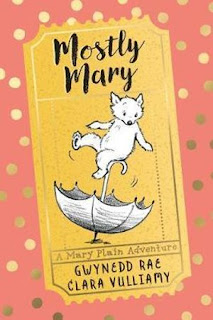
Book Reflection: Mostly Mary


Continuing my occasional series of reflections on books with bears in them, this week I’ll be looking at a chapter book for children:

Mostly Mary, by Gwynnedd Ray (illustrated by Clara Vulliamy).

I was introduced to Mary by a bear called Paddington.

I mean that, literally. I bought a hard cover edition of A Bear Called Paddington in Paddington station when I visited London (why wouldn’t you?) and the blurb on the book jacket included a very interesting sentence:

“Like Winnie the Pooh and Mary Plain, Paddington is a bear to remember.”

Now, I am quite familiar with Winnie the Pooh. Even if Disney hadn’t made sure I had that “tubby little cubby all stuffed with fluff” on my radar from an early age, I probably would have encountered Christopher Robin and the good folk of the 100 Aker Wood through the story books my mother bought for me as a child.

But Mary Plain? I’d never heard of her. Here she was, being mentioned in the same breath as Winnie the Pooh and Paddington (two much beloved bears), but she was a complete mystery to me.

Well, I did what any librarian would do. I googled Mary Plain and discovered she was the heroine of a series of books published from the 30s through to the 60s. She was, apparently, quite a popular character at one point. So why had I never heard of her?

Unfortunately, none of my libraries had a copy of any of the Mary Plain books, but it just so happened that four of the books had been recently reissued with new illustrations by Clara Vulliamy. I ordered the first two books, and sat down to meet a new friend.

There’s something you have to remember about Mostly Mary. It was written in 1930 as light entertainment for children. So it is a cheerful, light-hearted, entertaining book… about a terrible zoo that would never be built in a civilised society in this day and age.

I visited the bear pits in Bern a few years ago, and the old pits weren’t in use at the time – they now have the bears in a park along the river bank where they have some space to roam and grass and trees and things (although I understand these are connected to the pits with a tunnel, so the bears can use both spaces). When I saw the bear pits, it made me sad to think that bears would spend their whole lives in those concrete bunkers. Now, thanks to Mary Plain, I know that people also threw random crap at them while they were in there.

Gwynned Rae used to visit the zoo while she was living in Bern in the 1920s, and the bears were the highlight of the zoo for her. She imagined them as being like a family with small children, going about their business being bears in a pit, and that’s the angle from which she has written this book. Mary is very much like a child, but not completely anthropomorphised. The book consists of a series of stories (mostly about Mary, but some of the other bears take the lead in a few stories – hence the title). During these stories, the bears are playful, happy and interested in the world around them.

But they’re in a terrible zoo, during a time when people treated animals with little respect, and I kept coming across parts of the book that were supposed to be “oh, how dear!” moments, but were actually “well, that’s a bit sad, really” moments instead.

Mary overhears one of the humans commenting about her, saying “isn’t Mary plain?” and she thinks this must be her full name – she gets so excited and happy about this that she runs to her favourite part of the concrete bunker and hugs herself because there was no one else around to hug. People throw stuff at the bears all the time, and that’s pretty much the most interesting thing that happens to them, so they like to play with the random crap that has been tossed at them. People also throw food at them – often carrots bought from a stall, but also “treats” like honey and condensed milk, and the bears practically live for these moments. There is one lone tree in each of the pits, and they’ve been used so much that the lower branches are all broken off…

There’s a point in the book where Mary is put on a leash and taken to some rich person’s party. This is supposed to be an awfully big adventure for the young bear, but all I could think of is, “Really? This was something they did in the 20s? Rented bear cubs from the zoo as party tricks?”

And this charming, happy-go-lucky bear cub is just so excited to encounter every crappy part of her crappy little life.

I wanted to love this book, but we’re in a different place now (thank God), and it’s hard to love something that cheerfully celebrates a mistake we made in our ignorance that we regret deeply (at least, we should regret it deeply – I’m sure there are some people who don’t, but those people are the ones who never stopped to ask “but what must it be like?”).

A child who has never seen the pits and hasn’t got a full appreciation for how terrible the zoos from that time were would probably enjoy the book and fall in love with Mary. I wish them luck. Personally, I have to wait a little longer before I can bring myself to read the second one.

Friday, October 26, 2018

Book Reflection: I Want My Hat Back

I've decided to start an occasional (knowing me, very occasional) series of book reviews for books that have bears in them. Because I like bears. This isn't so much a review of the book as a review combined with a pointless ramble about where my brain went as a result of thinking about the book.

So, more of a "book reflection" than a "book review".

I'm kicking things off with my most recent purchase:

I Want My Hat Back, by Jon Klassen.

This book kind of sneaks up on you. The first time you read it, it seems a bit plodding and, dare I say it, not very interesting... right up until you get to the last few pages, when it's entirely possible you will find yourself uttering an involuntary "Hah!"

You see, the whole book is basically a wind up to a punchline. It's just a very subtle and understated wind up to a very neatly done punchline. It will no doubt tickle the funny bones of many children, and I expect many a household has been reduced to fits of giggles by this one. I wasn't rolling around on the floor laughing, but I'm also not three-to-five years old (and, sadly, do not have any three-to-five year old co-readers), so I'm not exactly the target audience. It still made me utter an involuntary "Hah!", and I had a smile on  my face at the end of it.

In subsequent readings, you know what is coming and you know how sly the humour is, so I can imagine scores of four-year-olds start giggling the minute they see the rabbit.

The bear you see on the cover of the book has lost its hat. It asks everyone it meets if they have seen its hat, but no one has... or is one of them lying?

The book is part of a trilogy of hat books, including We Found a Hat and This is Not My Hat. I haven't read the other books, but from what I can tell they are unrelated stories, linked purely by the central role a hat plays in the plot.

I mentioned above that I'm not three-to-five years old, and am therefore not in the target audience for this book. I haven't been three-to-five years old for quite some time now, and yet I've always maintained that such a technicality is no reason why I should stop reading picture books. I am also in a situation where I have no children in my life. I don't have any kids of my own, and I have no nephews or nieces. I am a librarian, but I'm an academic librarian, so I rarely read books to children (I've done it a few times in my job, but not for years).

I still think "childhood" is not a prerequisite for reading picture books written for children. I love poetry, art and good stories, and you get all of these things in abundance in the picture book section of the bookshop or library. So I happily borrow and buy these books for myself, even though I am not a child and I don't have any regular contact with children.

But I realised, on thinking about this book, that sometimes it helps to be four years old. I was a tired and grumpy adult when I read it for the first time. I had read a recommendation of the book by Jenny  Colgan, who that said it was very funny and made her laugh every time she read it. I was expecting it to be highly amusing. And yet I read it, and found it only mildly amusing. It was, I suppose, "laugh out loud" funny, in that I did, indeed, utter an involuntary "Hah!" But overall it was... well... "okay I guess?"

It was only on reflection that I realised a four-year-old would probably crack up at the point where I uttered my involuntary "Hah!" And would probably crack up every time they thought about it for hours afterwards. And would probably crack up in anticipation of that moment on subsequent re-readings. They would probably also crack up every time a member of their family answered a "have you seen my...?" question with "I haven't seen it. I wouldn't steal a ... Don't ask me any more questions."

You do see the world differently when you're only three-feet tall and you still enjoy knock-knock jokes about interrupting cows.

Sometimes I really miss being four.

Tuesday, August 28, 2018

Leftover Book Challenge Review: The Chronicles of Narnia

So, I have another left-over review that wasn't needed on my work blog for the Reading Challenge, and I may as well post it here. The challenge for this week was to read a trilogy or series.

Sharon B read the Chronicles of Narnia, by C.S. Lewis.

I have a theory about series that go beyond four books: They shouldn’t. A trilogy is great, and a series of four books is thoroughly enjoyable, but past the fourth book, things go a little south. Most series fall into the same pattern, I’ve found:
  • The first book is a new and exciting experience; you get caught up in the plot and the characters and you want to read more.
  • The second book can’t quite get out of the shadow of the first book; nine times out of ten it doesn’t really have legs as it’s own story, but you enjoy reading it because you get to spend more time with the characters you loved from the first book.
  • The third book manages to have a genuinely interesting plot, fills you with excitement and reminds you why you engaged with this series. Or it kind of sucks and you wonder what happened.
  • The fourth book is still good, and it can be the most mature and developed story of the whole series – but it’s often a completely different beast to the first book, and there’s something about it that feels like a natural ending.
  • Every book after that is moving further and further away from what you loved in the first book, and sometimes they just end up being kind of sad, really.
Now, I love The Chronicles of Narnia. I’ve loved them since I was a kid and I re-read them every now and then – and still love them. But they absolutely conform to my theory. Let’s look at them in publication order:
  • The Lion the Witch and the Wardrobe is one of the finest novels for children in the English language. It was a game-changer that has inspired countless copy-cats over the decades, and has a group of passionate fans who love it to pieces.
  • Prince Caspian is a wonderful opportunity to be reacquainted with the Pevensie kids and get back to Narnia for another adventure… but it’s not the most memorable book in the series, and the story isn’t a patch on the first book.*
  • The Voyage of the Dawn Treader is a rip-snorter of a story, and the bits that people love most about the series are probably in this book, if they weren’t in the first one. But we lost half the kids from the first book before we even started and, even though we picked up another kid, we lose the other characters we love at the end…
  • The Silver Chair (the Fourth Book in the series) is actually a really good book with a great story, but it doesn’t have any of the characters from TLtWatW, so it kind of feels as if the story that started in that book is well and truly over. If this had been the last book, it would have been a good book to end on.
  • The Horse and His Boy is an odd book that stands on its own well enough, but doesn’t feel like it belongs in the series. It’s in the “world”, but completely outside of the narrative of the first four books. If all of the references to “Narnia” were changed to “Elsia”, and “Aslan” was a hawk called “Elsor”, you’d never pick it as belonging to the series – and the series wouldn’t miss it if it wasn’t there.
  • The Magician’s Nephew is a prequel that takes away some of the wonder and mystery from the back-story of the first book by filling in gaps that didn’t need filling (how did a street lamp end up in the middle of the Narnian woods?). It’s okay, but it’s not great.**
  • The Last Battle is trying too hard to be an analogy, and forgets to be a fun book to read. It’s kind of sad and vaguely depressing and an unfitting end to the series – and I can’t forgive Lewis for what he did to Susan. The series should have stopped before this book.

*I have to admit I usually forget what happens in Prince Caspian. I've re-read it a couple of times, and every time it's like "oh, *that's* what was in this book".

**Having said that, I was given a box set of the series as a child which was in story-event order, not publication order. The Magician's Nephew was actually the first book in the series that I read, and I have fond memories of reading it as a child - especially some parts, like the "wood between the worlds". It's only on re-reading it now that I notice it's definitely post-fourth-book.

Newest post

The Western Novella

On my recent flights to and from Brisbane, I finally got around to reading a Cleveland Western novella I've apparently had in my handbag...

Popular posts