Showing posts with label reflections. Show all posts

Sunday, February 20, 2022

All That Can Be Contained: A Book Reflection

Photo by Jake Nebov
on Unsplash

(This is Part 3 of a group of book reflections about the same book. Part 1 is here. Part 2 is here.)

As you may recall from the previous posts in this series, I've recently listened to the audiobook version of Decluttering at the Speed of Life, by Dana K. White (read by the author).

One of the central tenants of White’s book is something she calls the Container Principle.

The Container Principle is both incredibly simple and obvious, and deeply profound. I suppose most fundamental principles are, whether they were discovered by a monk in a remote mountain cave or a mother of three with a clutter problem.

The Container Principle states that any given container (be it a drawer, a cupboard or your whole house) has two fundamental aspects – two things that make it a “container”. The first is, obviously, that it holds things. The second is that it limits what can be held. It contains, in multiple senses of the word.

We have a tendency to forget about that second aspect. We keep trying to put more into our containers than they can hold, but you can’t really do that. If you try to put more into a container than it will hold, you will put the container and everything in it under stress, which could lead to damage. Or it will overflow, and everything will spill out, and then gets out of control.

White’s definition of clutter (and I am very much paraphrasing at this point, as it has been several weeks since I listened to her book and I can’t remember the exact way she phrased it) is something that is out of place, out of control and causing stress. If it has a place to be, but it’s not in that place, then it is clutter in this place where it isn’t meant to be. If there isn’t a place for it to be, then it’s just clutter.

If it doesn’t belong, it’s clutter. I’ll come back to this in a moment.

Things that are spilling over the confines of their container are, in a very real sense, out of place and out of control. When your threshold for this kind of clutter maxes out, you find yourself under stress. It’s very likely that the “things” that the container is supposed to hold are also under stress (you can’t squish too much into a given space before something gets squished), and the container might very well be under stress as well.

When the stuff you're trying to fit in the container gets beyond what the container can hold, then the best and most sensible thing you can do to make sure things are properly cared for and don’t get damaged is to scale back so that you only have what will fit in the container.

Take it all out and evaluate it – as a whole, and in relation to everything else you wanted to put in that container. Don’t just look at each thing on its own and say “I want this”, look at each thing in relation to all the other things and say “I want this more than that”. Prioritise the most important, the best, your favourites – these go into the container first.

When the container is full, everything else that isn’t already in the container doesn’t fit. It wasn’t a priority, or it would already be in the container, and therefore it doesn’t have a place. It doesn’t belong in the container. So, if it doesn’t belong, it’s clutter.

If you want to avoid putting the system under stress, you have to be able to accept that you can’t keep everything all the time. If this thing that doesn’t fit isn’t more important, more loved or more useful than the things that are already in the container, then it has to go. And quickly – don’t leave it to become a burden.

Whenever you think of adding anything new to that container, you have to consider it on a “one-in-one-out” basis. Is it more important, useful or loved than something that is already in the container? If not, don’t bring it into your life. If it is, then the less important/loved/useful thing has to go.

You might think the obvious solution is to get a bigger container, but space isn’t infinite. A bigger container for this means there’s less space for something else. If you dedicate a second drawer to hold what doesn’t fit into one drawer, then you have less drawer space for what would otherwise have gone in the second drawer – you’ve moved the problem, you haven’t solved it.

White was talking about drawers and cupboards, but many things in our lives are containers.

Time is a container. Your mental or physical capacity is a container.

Any given container can only hold so much. You can only do so much in a day. You can only make so many decisions. You can only keep on top of so many tasks.

It’s harder to see these containers and their capacity (and certainly a lot harder for other people to see them and respect their limitations), but it’s actually quite easy to tell when they’ve been overstuffed and can’t hold what you are trying to contain: they are under stress, over flowing and getting out of control.

If you get to the end of your work day and you feel you have to stay back and keep working because you could not do everything you “had” to do today, then there is too much in your work day. It spills over and puts the system under stress. There are only so many hours in the day, so if you spend more time at work, there’s less time to spend doing all the things you “have” to do at home. You have a smaller container to try to fit your domestic tasks into. And so that spills over and takes time away from unwinding so you can get some rest…

So of course you feel like your days are overflowing and you have so many things you couldn’t get done today. You’re trying to fit too much into your day, and there are limits to what your container can hold.

If you find you are doing this every day, then there’s a bigger container issue at play. You’re trying to fit too much into something else. Perhaps your job has too many tasks to complete? If it’s more than you can do in the time you have available, then it’s too much work to fit into your job. If the “job” is supposed to fit all of this work into it, but it doesn’t, then perhaps that job doesn’t fit into your capacity – it doesn’t fit into your life.

We don’t like to think about this – we don’t like to admit it. We think we should be able to fit these things in, so we refuse to accept we can’t. We think we need to keep cramming stuff into the container until the container finally grows enough to accommodate all of it.

But that’s not how containers work. There are limits to what they can hold. If you keep pushing them beyond their limits, something is getting damaged, even if nothing obviously breaks.

So we need to look at everything we’re trying to fit into that container. We need to see everything in terms of whether it is more deserving of a place in that container than something else. We have to prioritise what is most important, most useful, most loved. And when the container is full, we have to be willing to say “there is no place for this – it wasn’t a priority and it doesn’t fit.”

And then we have to find a solution to that which doesn’t involve us continually trying to cram it in. Something that leaves us with enough space in our lives that we can actually enjoy what we have, rather than stressing about what is overflowing.

We also have to look at every new thing in relation to what is already in the container, and be honest about whether it’s more valuable to us than something that is already in there. Then we have to let something else go.

And that’s the hardest thing, I think. We’re so used to pretending we can do it all; we struggle with admitting we can’t and telling people that this is beyond what we can do. Also, we know everyone is in the same boat – everyone is stressed out trying to fit it all in and do all of the things. For some unfathomable reason we see that as a reason for why we should keep struggling, instead of realising we’re all making a mistake.

What if…

What if we gave each other permission to only do what we can – to stop trying to cram in more than our containers can hold? What if we gave ourselves permission to do this, and extended this kindness to everyone around us?


Thursday, February 3, 2022

My Home is not the Tip: A Book Reflection

publicdomainvectors.org

 (This is Part 2 of a group of book reflections about the same book. Part 1 is here, part 3 is here.)

As you may recall from the previous post, I've recently listened to the audiobook version of Decluttering at the Speed of Life, by Dana K. White (read by the author).

Like Part 1, this is more about a revelation inspired while/by listening to White's book, rather than necessarily something she said in the book itself - although she did touch on it closely enough that I feel it's legitimately something from the book.

At one point, White was discussing the fact that we (well, some of us) feel guilty about throwing things in the bin if there's any chance it could be put to use somehow. Perhaps we can turn that frayed T-Shirt into a craft project and give it a second life. Perhaps someone who is desperately poor will be desperate enough to want because it's better than the crap they currently have.

She didn't go all out and say this, but it was strongly implied: poor people don't deserve your trash just because they're poor. What she did say is something well worth saying: don't give something to charity that you wouldn't be willing to give to a friend.

If you ever do feel the compulsion to try to give something you regard as unworthy of your own friends and family to a poor person because "surely some one truly poor will be truly grateful", image that instead of saying "poor person" or "someone in need" you said "peasant." Because that's sort of where that mentality evolved from: the peasants should take whatever we give them and be grateful. Let's not be that person.

But the main reason most of us feel a need to hold onto something that's not completely in rags is the fact that we don't want to be wasteful. We want to try to find a way to keep it out of the rubbish tip by finding a way to reuse or recycle it. Surely?

That's a real problem I struggle with. I want to reduce the amount I throw in the bin by being less wasteful, so I hold onto something that could potentially turn into something else. But...

Many years ago I read an article (I wish I could remember the author - or even the source) written by a young mother, who had started using a mantra: "I am not the kitchen bin". She didn't want to waste the food her kids weren't finishing, or the scraps she had cut off the food she was preparing for a meal, so she'd eat them. She was gaining weight and her health was suffering, and one day she realised that if she was putting something into her own body to keep it out of the bin, then she was the bin. She had to get over her guilt about waste and respect her own body and boundaries instead.

"I am not the kitchen bin."

I've often thought of that over the years, as I've found myself eating food after I was full just because there wasn't enough to put aside as left overs and it seemed a waste to throw it out. Or as I ate something I had actually ruined and wasn't enjoying at all, simply because I'd made a batch of it and didn't want to be wasteful.

But I'm not the kitchen bin, and I'm not doing myself any favours by putting something in my face that I should be putting in the bin.

As I was listening to White talk about rubbish and the guilt we sometimes feel about throwing out something that could, potentially, maybe, some how, by some stretch of the imagination, be "still good", I suddenly realised:

"My house is not the rubbish tip."

If I'm not doing something with this rubbish, but just holding onto it in the hope that I find something to do with it later, I'm using my own house to store landfill. This is not, in any tangible way, less wasteful that sending it to the actual landfill (where at least they might do something to reduce its size, as the professional rubbish people are always looking for ways to handle rubbish volumes better). It's just sharing the rubbish between the tip and my house.

You "reduce" rubbish before it comes into your house. You look at anything you're thinking of buying for its potential rubbishness and you either come up with a better idea then and there, or you accept that you're going to be throwing something away.

This is something I really have to focus on: not keeping things I should throw away (because I don't like throwing things away), but rather making better choices at the start of the process so I don't get stuck with choices I don't like when that item has reached the end of its life.

I am not the kitchen bin, and my house is not the tip.

Wednesday, February 2, 2022

Ten-Year-Old Me Never Visits: A Book Reflection

(This is Part 1 of a group of reflections prompted by this book. Part 2 is here, part 3 is here.)

If you’ve read any of my “book reflections” before, you’ll know they’re a bit of a cross between me talking about a book I’ve read and me just rabbiting on about myself. This one is probably going to be more rabbiting on about myself than usual.


I’ve recent read yet another decluttering book (actually, I listened to the audiobook): Decluttering at the Speed of Life, by Dana K. White (who also read the audiobook).

If you read back over the posts I’ve written about books over the years, you’ll probably find quite a few books about decluttering, cleaning, tidying, organising… You may find yourself wondering if I’m some sort of neat freak whose house is unspeakably tidy, or if I’m a complete slob who reads decluttering books for inspiration but actually never properly gets her house in order, which is why I keep reading decluttering books.

Well, mostly it’s the latter, but I also just like reading decluttering and cleaning books. Like Romance novels, I find them a nice light “holiday” read – something comforting and familiar for when I don’t want to have to think too deeply about a plot or meaningful information.

I have to say White’s book is up there among the better ones I’ve read. She isn’t – how shall I put this? – noticeably insane. Rather, she’s someone who has noticed that decluttering is actually a lot like cleaning – it’s a constant process that never ends because you keep gathering new clutter, and eventually you’re going to have to declutter again. She’s also a recovering slob and a bower bird, so she writes from the perspective of knowing how stuff creeps up on you and how hard it is to declutter your “dreams”.

As I was listening to her read her book, I found myself often saying, “uhunh – you got that right” and “yeah, I hear that.” Unlike Marie Kondo, who was apparently raised by Home Beautiful magazines and has always had a compulsive aversion to untidy spaces, Dana has more of a relation to stuff that matches my own, so I could relate to what she said a little more. She also has a really good reading voice. You can tell she’s been a podcaster for a few years.

I often listen to these books while I’m sorting through a cupboard or doing housework, and there was a point during the middle of listening to this when I realised some of the things I’ve been holding onto for years as “favourite things” or “beloved treasures” weren’t actually for me at all. Well, they were, but they weren’t…

I realised I have been holding onto a lot of stuff in case 10-Year-Old Me comes to visit. This isn’t the first time I’ve noticed this, but this time it really hit home.

My mother was a single parent. Most of her friends who had kids around my age moved Down South almost before I was born, and her other friends either had grown children who had left home or didn’t have any kids. When she would go visiting her friends from university or Church, I would get dragged in tow because there wasn’t anyone to babysit, and I’d end up going through whatever “treasures” were at the homes of her friends. Looking at their nick-knacks, photos of holidays, boxes of old comics and random books…

These were the things people dumped on me to keep me occupied while they had proper conversations in the next room, and I loved them. I loved looking at the weird ceramic thingies people had collected over the years, I loved pouring through old holiday brochures from the 70s – and I especially loved getting to go through someone’s old comic book collection or the toys their kids played with 10 years ago.

Essentially, I loved this clutter that other people had kept, and so part of me was keeping the same kind of clutter – not because “Adult Sharon” still looked at it or paid any attention to it at all, but because I instinctively knew that if 10-Year-Old Me dropped by, she’d love looking through this stuff.

And I guess I have sort of been keeping it for the next kid. The grandkids I’m never going to have because I never wanted children. The nephews and nieces I’m never going to have because I have no siblings and the only cousins who have kids aren’t close and aren’t visiting. The “friends’ kids” who aren’t going to visit because the only friends I have with children usually leave them with the other parent when we hang out – and we usually go out to socialise, we don’t visit each other’s houses.

I’ve been keeping photographs that no one is going to care about except me – and I stopped caring about half of them years ago. I’ve been keeping books, toys and trinkets for “some kid” to play with, but the only way any child is going to play with them is if these things leave the house. And I’ve been keeping things that I don’t particularly want and no one else is going to want either (because they’re old and ratty or damaged), because if I manage to go back in time and meet up with my younger self, that kid loved playing with them – but no child is ever going to play with them again, and neither am I.

So much of what I’ve held onto has been for a version of me that doesn’t exist. If not 10-Year-Old Me who loved looking at old junk kept in boxes, then 20-Year-Old Me who collected stuff out of some weird idea that the collection itself meant something – that one day I’d have some sort of tourist attraction consisting of my ridiculous number of DC Superhero posters and DVDs or my massive collection of Tarzan movies. I have movies I’ve never watched and books I’ve never read, but carried with me from place to place and spent vast sums of money accumulating, because they fit in with some collection that meant something to me… once.

But quite frankly, I’m never going to open a “Museum of Pop Culture Hero Crap”. And no one else is, either. This was someone else’s passion that they were trying to turn into a project. I’m holding onto it for them, but the truth is they don’t exist anymore. I know, because I replaced them.

And while a part of me knew that I was no longer interested in these things, some part of me has still been keeping it for the next kid. But there isn’t going to be a next kid. I’m holding onto it for a ghost and a phantom.

And let’s not forget the unrequited dreams – all the things I was going to be. The person who made toys out of scrap material, who whittled, who played dozens of musical instruments, who took up all sorts of hobbies for which I have some of the stuff. I still don’t want to admit I’m never going to do that thing or be that person… but…

Ghosts and phantoms. I’m holding on their stuff. But maybe I’m finally reaching the point where I don’t want to.

Saturday, March 13, 2021

A Monk's Guide to a Clean House and Mind (a Book Reflection)

 It has been far too long since I have reviewed/reflected upon a book. For those of you who haven't come across one of my "Book Reflections" before, it's basically a gonzo book review - I'm ostensibly reviewing the book, but mostly just talking about my own ideas and opinions.


Today I'm talking about A Monk's Guide to a Clean House and Mind, by Shoukei Matsumoto.

This is an "Amazon knows me too well" find. Because I read books about Zen, and books about tidying and decluttering, the Amazon algorithms recommended a book about cleaning written by a Zen monk. This is, by the way, why I'm happy with this Faustian deal I've got going with Amazon - yes, they are the devil and they know too much about me and my reading habits... but dang that's come in handy.

Matsumoto's book is not technically about decluttering, but if you followed the advice in this book you probably wouldn't own a lot of clutter after a while - if for no other reason than the fact that you have to clean it.

If I was going to summarise the book in one sentence, it would be to "clean everything often and well so the dirt doesn't get you down."

Like many of the other self-help books I read for fun (and for which I am very bad at taking the advice contained therein), I found the book to be a mixture of "good, practical advice" and "that's totally nuts". It's not as crazy as Kondo's The Life Changing Magic of Tidying (Matsumoto never once suggests storing carrots upright in the fridge), but there is a deep and abiding flaw in the book that he never addresses, and it is impossible to take on his advice properly with this flaw in the way. But I'll come back to that. First, I want to talk about the dirt on my heart.

Matsumoto is constantly talking about how dirt on this or that is dirt on your "heart". How the ink stain on the cuffs of your sleeves is a stain on your heart. How the dust on the floor is dust on your heart. An insufficiently cleaned bathroom reflects on the heart of the person who was supposed to clean it as well as weighing on the mind of everyone who uses it. This is a refrain he comes back to over and over again in the book: we clean to rid the dirt on our hearts and minds.

I was really struggling with this language and definitely leaning towards the "you're a little bit insane" interpretation of his book, before I suddenly asked myself what he meant by "heart". I was taking it from a Judeo-Christian, Western view of things were the idea of "dirt on your heart" meant that you were deeply flawed and a terrible person. But then I started to wonder if "heart", in the context of this book, wasn't one's "essential essence" or "soul" (which was a very weird attitude for a Zen monk to have, it must be said), but rather one's sense of happiness and joy. 

We sometimes talk about "heart's ease", things that are "good for the heart", or having something "weighing on our hearts". There are things that dampen our spirits and lift our spirits, but have nothing to do with our "Spirit" (capital S). And I think, this is what Matsumoto is getting at when he talks about cleaning our hearts. We are far more intertwined with our environment than we realise (and even if we do realise it, we tend to forget), and seeing jobs of cleaning and maintenance left undone in our world weighs on us in ways we're not always conscious of.

Dust, stains and broken things that need mending get us down. They tickle at the backs of our minds, stopping us from being completely at ease. Taking the time to clean it/fix it lifts our spirits. Taking the time, every day (or at least on regular days), to keep things clean and mended makes as feel generally better about the universe.

This book is a mixture of "how to" advice for cleaning (as gleaned from centuries of monks taking care of their temples and grounds) and philosophy about the relationship between people and their environment and objects. And, yes, you will probably end up owning fewer things and taking better care of them, because it's not really possible to have a giant household full of stuff and keep it all clean and well tended.

And now for the deep, abiding flaw:

Matsumoto is a monk. He's a monk at a Zen temple with other monks where all of the monks clean the temple all day. That's what they do, that's what their day consists of - "service" (i.e., cleaning) and meditation - and there's a bunch of them to do it. They rotate the tasks so the person cleaning the floors on Tuesday might be tending the garden on Wednesday. The advice he gives on cleaning is based in a reality where a) a task is done everyday or at least several times a week, b) the person doing the task has time to do it well, and c) there are enough people around to do the tasks to make sure they are all done every day or at least every other day.

As a single person with a full time job, I look at much of what he says in the book and think "that's not physically possible - I would have to be in two places at once for every single hour of the day to do all of the supposedly 'daily' tasks." I would have to be or have a full-time housekeeper to keep on top of it all - and then I'd probably need a groundskeeper as well. It simply cannot work in a world where you don't have at least one person whose entire job consists of taking care of things. 

Now, there are days when I long for that to be my schtick. I could happily play monk for a while and just sweep the floors and clean the kitchen and bathroom all day. Who knows, one day I just might do this. But I'm not financially in a position to do it at the moment. I doubt most people are.

I am probably going to start cleaning more things more often, though. I've already started doing this with my desk at work, and it is definitely calming and relaxing to start the day with clearing away whatever dust might have accumulated in my space.

I was saying to someone recently that I'm thinking of developing a cleaning disorder. Hopefully, if I cultivate it on purpose, I'll be able to put it to good use without becoming too obsessive about it. And even if it does get out of hand, it's better for my health than other "disorders" and I might be able to make a living out of it - hey, it worked for Marie Kondo.


Friday, April 10, 2020

Book Reflection: Zen Master Raven

It has been a while since I've written a "book reflection", so it might be worth my while explaining what they are again, before I get stuck into this one. It's a bit of a gonzo book review - I'm ostensibly reviewing a particular book, but I'm really just talking about myself and using the book as a medium. Sometimes my "book reflections" are more focused on the book than they are on me, sometimes they're more focused on me than they are on the book. Sometimes (well, probably more often than not), they just reveal me to be a bit of an opinionated jerk. Such is life. Now, onto this reflection:


I've just started reading this book for the fourth or fifth time. I've kind of lost track. And it's not like I've had the book for years and I come back to it after I've had a chance to forget most of it, I'm actually reading it consecutively. I get to the end of the book, think "that was nice", and then flick thorough it the way one does when one has finished a book one enjoyed... and then I just end up going back to the beginning and starting it again. 

Zen Master Raven: The Teachings of a Wise Old Bird, by Robert Aitken, was an early purchase for trying out a new Kindle. I had just bought an eBook reader for the first time, and I was picking up a bunch of books from different genres to play with my new toy. One recommendation lead to another, and Zen Master Raven ended up being one of my first purchases.

It was the first book I have read by Robert Aitken. I’ve since picked up a few more of his books – also on the Kindle. It’s become something I do at doctor’s surgeries and other places where I know I’m going to be waiting around for an interminable period of time: I read Aitken. I find his writing undemanding and yet stimulating. It doesn’t seem to matter that I’m hovering in some limbo where I could be interrupted at any moment (but will probably be kept waiting for another half an hour). I think his writing style is just pitched at the right level of easy-going conversation about deep and meaningful things.

It has also put me in a bit of a weird spot when I find one of his books in print in a bookshop (which has happened a couple of times but is, I’ll admit a rare occurrence). Part of me wants to buy the book because I enjoy his writing and don’t have any hard copies of his books. The rest of me doesn’t want to buy a book when I already own a copy. It’s a strange side-effect of owning a Kindle: you both own and don’t own the books at the same time.

If I ever did stumble across a print version of Zen Master Raven again, I probably would buy it (even though I won’t go out of my way to get one, because I already own the book), simply because it has become one of my favourite books and I’d love to be able to lend it to people who might enjoy it.

It’s an odd bingdingle of a book – a collection of fables written for grown-ups by a retired Zen Buddhist priest. It’s surprisingly hard to say what the book is, as I have no idea what genre it might belong to. I can only really tell you what it’s (sort of) about.

Raven (a bird), after talking to a number of Zen masters, finds a teacher in the form of Brown Bear (a bear – these aren’t people with critter names, they’re critters). After studying with Brown Bear for a while, he becomes a Zen teacher himself, and establishes a Zen community in Tall Spruce forest, where creatures as diverse as moles, badgers, woodpeckers, wolverines and porcupines come to sit together for zazen around the Assembly Oak and ask Raven questions about Zen (as well as life, the universe and everything).

These short fables aren’t really fables, as there isn’t much of a plot to them, they’re more conversations. They fit in perfectly well with a lot of traditional Buddhist literature (especially within the Zen schools) which basically consist of Monk X asking Master Y a question and getting what appears to be a ridiculous answer in return. In these stories (often featuring in books of koans), the answer is meant to challenge the assumptions behind the question – and the assumptions you brought to the table when you read the koan in the first place. Once your frame of reference has shifted, the answer isn’t ridiculous at all.

That’s what these fables in Raven are – short conversations in which the meaning shifts around depending on where your understanding happens to be at the time. In addition to other works by Aitken (including commentaries on koans), I’ve been reading books by other Zen teachers, and I swear that every time I re-read Raven, I’m picking up something new. I’ll notice that a character isn’t being treated the way I originally thought, but rather he’s been pushed to realise he’s got the wrong end of the stick. I’ll notice that an answer given to a question I originally read one way is actually quite profound for completely different reasons.

And because I’m underlining things that make me smile, or make me think, or just really appeal to me at the time, I’m coming across things I underlined on my first reading that now mean something different to me – or which were so of that moment in time that I can’t remember why I underlined them in the first place.

The stories and characters are the kind of thing we would normally regard as being “for children” – but they aren’t really. It’s not that they are unsuitable for children – the language isn’t beyond kids and it’s not not for children – it’s just that the stories make very little sense if you aren’t studying or practicing (or at least reading up on) Zen. You could read them to children, but I don’t know why you would. I expect most children would find them boring, confusing and utterly pointless. And those who did enjoy them would probably look back on them as an adult and realise they had missed the point entirely.

I expect I’ll look back on them in my old age and realise I’ve missed the point entirely.

I guess what they really are is koans for Westerners – for those of us who grew up with stories of Goldilocks and the Three Bears and Br'er Rabbit. The trouble with the “serious” koans in the “serious” koan collections is they come from another time and place and culture. Half the time you miss the subtleties of what’s going on, because someone needs to explain the undercurrent. These tales belong to a more familiar cultural milieu, so it can challenge your view of things without needing to explain what’s going on first.

The reason why I’ve read the book so often is because it’s perfect bed-time reading. I like to read something short and “devotional” before I go to bed. It’s a longstanding habit from my days as a devout Christian, when I used to read actual devotionals. I really love the genre and format of devotionals. They are complete works – you read one short page of text and you’ve read the whole thing, so you can just put down the book after that page and not get suckered into reading another one “just to see what happens next…” They often have a little bit of a story, and maybe also a few lines of verse, and they leave you with a thought. Sometimes it’s a warm fuzzy thought (“God is looking out for you”), sometimes it’s a challenging thought (“are you making the most of your time on this earth?”). At no point is it such a demanding thought that you’ll be lying awake at night trying to nut it out.

I’m not a great sleeper, but I do notice that I sleep better after reading a devotional than I do after I’ve read almost anything else. Zen Master Raven’s tales give me the same “hit” as a devotional. They’re short and complete, and it doesn’t matter if I’ve been up late fussing about things I should have dealt with hours ago, I can still fit in one or two tales to help settle my brain before turning in.

Oh, and it also fits in quite nicely with my fledgling collection of books with bears in them. In addition to Brown Bear, Raven’s teacher, there is also Black Bear – a student of Raven who is slowly working out what it’s all about.

One of my favourite lines in the book belongs to Brown Bear, and I’ll leave you with it:
Owl said, “What are Right Views?”
Brown Bear said, “We’re in it together, and we don’t have much time.”

Tuesday, July 9, 2019

Book Reflection: You’re All My Favourites


You’re All My Favourites, by Sam McBratney, illustrated by Anita Jeram.

You may remember Sam McBratney and Anita Jeram from the classic 1994 picture book, Guess How Much I Love You (which is available in three thousand different iterations), or, as I know it best, Weißt du eigentlich, wie lieb ich dich hab? I read the book in German before I found a copy in English, and I’ve read the German version a few times but I’ve only read the English version once.

You’re All My Favourites, however, I have only read in English. Quite frankly I think I’d like it better if it was in German. It’s a nice enough book with a nice enough story (such as it is), and I’m sure there are kids out there who regard it as one of their favourites. I just thought it was lacking some of the pizzazz of the book with the hares. It’s not as playful.

There’s a nuclear family with a mother, father and three baby bears. The three siblings all wonder whether or not their parents like the other kids better than them – maybe the other two are the “favourites”? And, of course, by the end of the book, their parents reassure them that they are all their favourites. It’s a nice little book with a nice little message, and parents will no doubt jump at the chance to have a picture book that explicitly reassures small children that their parents don’t have a favourite (which is, of course, not at all true – although the same kid isn’t always the favourite kid).

And therein lies the rub, I think. I feel like this book was written specifically to give a message. Like those books that are designed to teach kids that pooping is perfectly natural (I still wonder why we need so many of those), or that blended families are “okay”. It’s not really a story, per se. That’s probably why it’s not as charming as Guess How Much I Love You, which had a lovely little story.

Also, don’t give this book to a kid who actually knows anything about bears. That whole nuclear family scenario is completely inaccurate for the species. It’s not unheard of for a bear to have three cubs, but two is more common, and the father certainly doesn’t stick around to help raise the kids. In fact, there’s an excellent chance he will try to kill them if he sees them, so it’s probably best if he’s out of the picture.

Monday, April 29, 2019

Book Reflection: Maudie and Bear


Now, this book I loved. I read this book twice in one evening because I finished it, and then wanted to dive straight back into it again. I think I read it at least six times on the first weekend after I borrowed it, and I've gone back to it a few times since. I love it now, as a grown up fan of picture books, and I would have loved it as a child, when I used to deep dive into books like this and spend hours pouring over the pictures.

I think I loved this book from the moment I saw the bear riding the bicycle on the front cover – but not just because bears and bicycles are two of my favourite things. There was something highly evocative about the picture, and the book kept that magic going throughout the whole experience. There’s something entirely timeless about this book. It was published in 2010, but if I had found it back when I was a child in the 1980s, nothing would have seemed out of place to me at all. Maybe that’s why it appeals to me so much – because it feels like a book I did read and love when I was a child, even though it isn’t one.

The book is a collection of short stories (not something I often get to say when talking about picture books aimed at five-year-olds), which each feature lovely little vignettes about a girl called Maudie and the bear who appears to be her primary caregiver. It's unclear what the exact relationship is for the bear and Maudie, but if you replaced "bear" with "grandpa", the entire book would still make perfect sense. Not that a girl being cared for by a bear doesn't make perfect sense.

The book seems to me to be a bit like an alternate reality version of Little Dee – a comic strip by Chris Baldwin in which a lost girl is adopted by a kindly bear named Ted. It also has some similarities with the television programme Bear in the Big Blue House, which also features a kindly bear as the gentle head of the household (he spent his time patiently wrangling characters who were a lot like young children as well).

In Little Dee, the bear and his makeshift family (which includes a runaway dog and a vulture, for some unfathomable reason) live in a cave in the woods. In Maudie and Bear, the girl and her ursine guardian live in a lovely Federation style house in what is clearly an Australian country town. If I were to hazard a guess, I’d say somewhere in Victoria, although I’ve seen houses and buildings like that in Queensland, New South Wales and Tasmania.

The book never actually tells you or shows you where it is set, but I know that style of architecture so well that I can’t imagine the book could be set anywhere but “here”, if you know what I mean. Plus, there’s a scene in which a lorikeet is sitting on Bear’s head and a couple of currawongs are on the ground in front of him.

But, even without the birds, the illustrations are still so evocative of “place” that the book is endowed with a kind of magic realism that makes it seem perfectly natural that this is an Australian country town in which talking bears wear hats, rake leaves, wash floors, ride bicycles and raise human girls. Every now and then I find a book where I feel like I could take a vacation in the artwork – just jump into the pictures Mary-Poppins-style and have a lovely time there for a while. This is one of those books.

And the stories are all lovely, too. While Maudie could do with pulling her head in occasionally, the relationship between the girl and the bear is just charming. I particularly like the way Bear “thinks about” Maudie’s temper tantrum by leaving her to it while he has a cup of tea and a piece of cake. I would actually recommend this book for fathers, grandfathers or uncles of young girls. It’s exactly the kind of book that a kindly male role model should share with his three-to-five year old little girl.

This is one of those library finds that I wanted to buy for myself, but it's a little out of print at the moment (apparently the publishers aren't sure if it's worth reprinting - I would like to say to them that it most definitely is). Copies are currently selling for $80 in the few bookshops that have them at present, and while I can honestly say this is currently one of my favourite books, I don't love it that much.

I did track down a copy in German for less than $40, though, so that will be fun when it arrives. But the title of the German book is Marrietta und ihr Bär, which seems wrong to me. Bear isn't Maudie's bear - he's just Bear. And Maudie is as much his Maudie as he's her bear.

Monday, April 8, 2019

Book Reflection: The Great Bear


On first reading, I did not like this book. I thought the illustrations were ugly and kind of disturbing, and I thought the plot was perfunctory and kind of depressing.

However, I was willing to concede that I hadn’t exactly given it the best of reading environments. I had been gathering books in my library for a display that had the theme “Religion and Philosophy”, and I was specifically looking for children’s books and picture books which could fit the theme (however loosely).... and I may have picked up a couple of books featuring bears while I was at it.

I’ll admit that the bear books were picked up more for me than for the display. One of them (which I will review later) had nothing to do with religion or philosophy at all, but The Great Bear looked like it might have a tangential connection to the theme, so I quickly read it to see if I had collected it for the display after all. A quick reading while standing next to a pile of books that I’d dumped on someone else’s desk wasn’t the best treatment, so I wasn’t sure if the book itself was perfunctory or just my treatment of it.

So I took it home and read it “properly”. As I read it, I realised that the illustrations were from the perspective of the bear (a dancing bear in a travelling circus who was used to people poking her with sticks and throwing rocks at her), so it made sense that they would be ugly and kind of disturbing. I started to think it was really quite clever.

But then, the plot was both too deep for most children, and not deep enough for grown ups. And half-way through the book the illustrations stopped being from the perspective of the bear, and the story stopped using words entirely – it’s like Gleeson and Greder set up one method of story telling but switched to another half-way through. And in the end I felt a bit let down by the whole thing (even though I’d come around to thinking the illustrations, while still ugly and disturbing, were also interesting and nuanced).

So, on second reading, I did not like this book. I wouldn’t buy it for any children I know, and I wouldn’t buy it for myself. But I might recommend it to an artist friend of mine who likes things I don’t like. She’d probably really enjoy it.

Wednesday, January 2, 2019

Book Reflection: Another Book About Bears.


It just so happens, when you’ve set yourself a mini-challenge of writing book reviews/reflections about books with bears in them, that you end up spending a lot of time talking about children’s books. Bears are very popular animals for children’s books, and they slowly peter out by the time you get to books for older readers, young adults or old adults.

It’s like that meme that was doing the rounds on the Internet a little while ago – when you’re a child people ask you what your favourite dinosaur is, but when you grow up they stop asking, like they don’t even care any more. For the record, I’m fond of the elasmosaurus – although technically the underwater critters aren’t dinosaurs, they’re marine reptiles. I don’t know why.

Anyway, the point is that kids books are rife with bears. And this is something that the Buntings point out (to great effect) in Another Book About Bears. The book begins with a typical story-book set up, “once upon a time there was a bear” sort of thing, but the bear in the book almost immediately interrupts the story to complain about how much work bears have to do because they’re in so many darn stories. They’d love to take a nap or eat dinner, but no – someone wants to read another book about bears, so they have to drop what they’re doing and “perform” the story.

Now, I’d really love to read the text behind the bear as he’s* interrupting said story.  There’s something about an Esquilax and a horse with the something of a rabbit and the body of something else. Anyhoo, that’s beside the point, as the rest of the book focuses on the bear and his fellow ursines trying to get out of being in another book by recommending a litany of other animals to replace them.

The book made me chuckle the whole way through – no problem engaging my inner four-year-old with this one.

It also put me in mind of the Thursday Next series by Jasper Fforde. In that series, characters in books have a life to live behind the scenes, but have to perform the story every time someone reads it – much like the bears in this book. It’s an interesting idea, and it’s interesting to encounter it again here.

Jasper Fforde, incidentally, wrote a book about bears that wasn’t a children’s book, and I’ll be looking at that little gem at some point in the future.

In the meantime, if you get the chance, do make sure you read Another Book About Bears. You’ll be glad you did.


*Have you ever notice that most of the books about bears where there is one central bear in the story, the bear is a “he”? I find that interesting, and if anyone can think of any books featuring an ursine central character who is a “she”, I’d very much like to hear about it.

Sunday, December 23, 2018

Book Reflection: Ojibway Heritage


Now, when I said my "books with bears" thing was going to be "semi-regular", I did, of course, mean "actually quite random".

Nevertheless, I have one for you today:

Sharon read Ojibway Heritage, by Basil Johnston.

Should you ask me to recite the first chapter of The Song of Hiawatha, I probably could. Not as well as I used to be able to, back when I was rehearsing it regularly for a Speech exam (yes, I’m one of those kids), but I’d probably get most of it out. I occasionally burst into sections of it for no apparent reason anyway (although most people just think I’m insane, not reciting a particular poem). And I have to admit that the trochaic tetrameter comes to me a little too naturally.

In a way I guess you could say
That this rhythm almost haunts me
But it is a happy haunting -
Happy for it keeps me busy.
Any time I need to churn out
Verses for a rhyme or reason
This will rise up, deep within me
And produce a likely poem.

I love the way the lines don’t have to rhyme to produce a properly poem-y poem – although sometimes I feel like being a smart-arse and trying to get a rhyme scheme in there, too.

So, why am I waffling on about The Song of Hiawatha? Because I recently read Basil Johnston’s Ojibway Heritage – I managed to shoe-horn it into my library’s Reading Challenge as being set in a country I’ve never been to. It fits into that category three times over. I’ve never been to the Ojibway Countries, and I’ve never been to Canada or the USA, which are currently sharing the Ojibway Countries. It also has bears in it, although I didn’t mention that for the review I wrote for my work blog.

As Johnston points out, the Ojibway believe that bears symbolise strength and courage (which is actually one of the reasons why I have a bear tattoo), they offer wisdom and guidance during quests and ceremonies, and they make good eating if you can kill one before it kills you. The Ojibway have an interesting relationship with animals, as they both revere them and revere the hunting of them. The idea is to do it respectfully, and thank the animal for its (somewhat involuntary) sacrifice. Actually, their attitude towards omnivorism is pretty good – live a good and noble life, and do as much good as you can in your life, to justify the lives lost to feed you.

Johnston’s book (a mixture of explanatory text, poetry and stories) elucidates the Ojibway spiritual take on the world – their faith and some of the structure of their religion. It’s a lovely way to see the world, I must say. I loved the idea that each plant has it’s own spirit, but the plants (and rocks) in a particular area also combine together to create a spirit of place that you can feel while you are there. I felt exactly that recently when I visited a nature reserve in Sydney – there was one area in particular that had a really strong vibe to it, and I found I had to slow down and just be in it for a while.

The hierarchy of the orders of things was also pretty marvellous. Like the Judeo-Christian faiths, the Ojibway believe that a Great Spirit created the physical world first (rocks, earth, sun, moon), then the plant life, then the animals, and then humans after everything else was in place. Unlike the Judeo-Christian faiths, they don’t believe everything was created for mankind, but rather that mankind was at the tail end of the process because we can’t survive without all the other parts – we are the weakest and feeblest of all creation. Animals will survive without us. Plants will survive without animals (well, some will at any rate – the birds and insects do help out a lot of plants), and the soil and rocks will survive without any of it. We are not more important than what comes before us and sustains us, and we should treat our “parents” and our “elder brothers and sisters” with respect.

I really, really like a lot of the Ojibway world view Johnston outlines in this book. I kept thinking, “well, I guess I’m going to have to convert” as I read… but there’s something that’s got me thinking. I’m not sure, as someone who doesn’t have a drop of Native American blood in me (as far as I know – I haven’t done one of those DNA tests), if I’m allowed to convert to their religion. Or, as is more likely to happen, as I’m not part of the culture, take on aspects of their religion as my own. That’s probably cultural appropriation, which is a bit of a no-no at present. You can convert to Christianity, Buddhism, Islam, Baha’i or any number of other faiths, but can you convert to a “native” faith when you’re not a “native”?

Speaking of “native” – that’s a word that’s fraught with baggage. It tends to be something that was used by White Men of Longfellow’s vintage to imply a kind of cultural inferiority. An example of how a useful word can be given an unfortunate connotation that makes it something you can’t use any more. And speaking of White Men of Longfellow’s vintage, it really pains me to note that my beloved Song of Hiawatha has its own share of casual racism. That sucks. One of my favourite lines in the poem is one of the worst: “the feeble hands and helpless, groping blindly in the darkness, touch God’s right had in that darkness and are lifted up and strengthened” – which, in my teens, I always took to apply to all of us (and I still think it does apply to all of us), but in hindsight it was almost definitely written as a “poor heathens don’t know the True Faith of Christianity” reference. Humph.

I have never been to Obijway territory, and I have never met an Ojibway person, but there’s just something about that culture and that landscape (seen only in film and photographs) that makes me feel a strange wistfulness, like the song Gonzo sang in the first Muppet Movie – I’ve never been there, but I’m going to go back there some day.


Friday, November 2, 2018

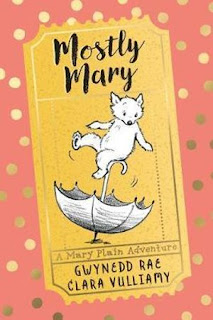
Book Reflection: Mostly Mary


Continuing my occasional series of reflections on books with bears in them, this week I’ll be looking at a chapter book for children:

Mostly Mary, by Gwynnedd Ray (illustrated by Clara Vulliamy).

I was introduced to Mary by a bear called Paddington.

I mean that, literally. I bought a hard cover edition of A Bear Called Paddington in Paddington station when I visited London (why wouldn’t you?) and the blurb on the book jacket included a very interesting sentence:

“Like Winnie the Pooh and Mary Plain, Paddington is a bear to remember.”

Now, I am quite familiar with Winnie the Pooh. Even if Disney hadn’t made sure I had that “tubby little cubby all stuffed with fluff” on my radar from an early age, I probably would have encountered Christopher Robin and the good folk of the 100 Aker Wood through the story books my mother bought for me as a child.

But Mary Plain? I’d never heard of her. Here she was, being mentioned in the same breath as Winnie the Pooh and Paddington (two much beloved bears), but she was a complete mystery to me.

Well, I did what any librarian would do. I googled Mary Plain and discovered she was the heroine of a series of books published from the 30s through to the 60s. She was, apparently, quite a popular character at one point. So why had I never heard of her?

Unfortunately, none of my libraries had a copy of any of the Mary Plain books, but it just so happened that four of the books had been recently reissued with new illustrations by Clara Vulliamy. I ordered the first two books, and sat down to meet a new friend.

There’s something you have to remember about Mostly Mary. It was written in 1930 as light entertainment for children. So it is a cheerful, light-hearted, entertaining book… about a terrible zoo that would never be built in a civilised society in this day and age.

I visited the bear pits in Bern a few years ago, and the old pits weren’t in use at the time – they now have the bears in a park along the river bank where they have some space to roam and grass and trees and things (although I understand these are connected to the pits with a tunnel, so the bears can use both spaces). When I saw the bear pits, it made me sad to think that bears would spend their whole lives in those concrete bunkers. Now, thanks to Mary Plain, I know that people also threw random crap at them while they were in there.

Gwynned Rae used to visit the zoo while she was living in Bern in the 1920s, and the bears were the highlight of the zoo for her. She imagined them as being like a family with small children, going about their business being bears in a pit, and that’s the angle from which she has written this book. Mary is very much like a child, but not completely anthropomorphised. The book consists of a series of stories (mostly about Mary, but some of the other bears take the lead in a few stories – hence the title). During these stories, the bears are playful, happy and interested in the world around them.

But they’re in a terrible zoo, during a time when people treated animals with little respect, and I kept coming across parts of the book that were supposed to be “oh, how dear!” moments, but were actually “well, that’s a bit sad, really” moments instead.

Mary overhears one of the humans commenting about her, saying “isn’t Mary plain?” and she thinks this must be her full name – she gets so excited and happy about this that she runs to her favourite part of the concrete bunker and hugs herself because there was no one else around to hug. People throw stuff at the bears all the time, and that’s pretty much the most interesting thing that happens to them, so they like to play with the random crap that has been tossed at them. People also throw food at them – often carrots bought from a stall, but also “treats” like honey and condensed milk, and the bears practically live for these moments. There is one lone tree in each of the pits, and they’ve been used so much that the lower branches are all broken off…

There’s a point in the book where Mary is put on a leash and taken to some rich person’s party. This is supposed to be an awfully big adventure for the young bear, but all I could think of is, “Really? This was something they did in the 20s? Rented bear cubs from the zoo as party tricks?”

And this charming, happy-go-lucky bear cub is just so excited to encounter every crappy part of her crappy little life.

I wanted to love this book, but we’re in a different place now (thank God), and it’s hard to love something that cheerfully celebrates a mistake we made in our ignorance that we regret deeply (at least, we should regret it deeply – I’m sure there are some people who don’t, but those people are the ones who never stopped to ask “but what must it be like?”).

A child who has never seen the pits and hasn’t got a full appreciation for how terrible the zoos from that time were would probably enjoy the book and fall in love with Mary. I wish them luck. Personally, I have to wait a little longer before I can bring myself to read the second one.

Friday, October 26, 2018

Book Reflection: I Want My Hat Back

I've decided to start an occasional (knowing me, very occasional) series of book reviews for books that have bears in them. Because I like bears. This isn't so much a review of the book as a review combined with a pointless ramble about where my brain went as a result of thinking about the book.

So, more of a "book reflection" than a "book review".

I'm kicking things off with my most recent purchase:

I Want My Hat Back, by Jon Klassen.

This book kind of sneaks up on you. The first time you read it, it seems a bit plodding and, dare I say it, not very interesting... right up until you get to the last few pages, when it's entirely possible you will find yourself uttering an involuntary "Hah!"

You see, the whole book is basically a wind up to a punchline. It's just a very subtle and understated wind up to a very neatly done punchline. It will no doubt tickle the funny bones of many children, and I expect many a household has been reduced to fits of giggles by this one. I wasn't rolling around on the floor laughing, but I'm also not three-to-five years old (and, sadly, do not have any three-to-five year old co-readers), so I'm not exactly the target audience. It still made me utter an involuntary "Hah!", and I had a smile on  my face at the end of it.

In subsequent readings, you know what is coming and you know how sly the humour is, so I can imagine scores of four-year-olds start giggling the minute they see the rabbit.

The bear you see on the cover of the book has lost its hat. It asks everyone it meets if they have seen its hat, but no one has... or is one of them lying?

The book is part of a trilogy of hat books, including We Found a Hat and This is Not My Hat. I haven't read the other books, but from what I can tell they are unrelated stories, linked purely by the central role a hat plays in the plot.

I mentioned above that I'm not three-to-five years old, and am therefore not in the target audience for this book. I haven't been three-to-five years old for quite some time now, and yet I've always maintained that such a technicality is no reason why I should stop reading picture books. I am also in a situation where I have no children in my life. I don't have any kids of my own, and I have no nephews or nieces. I am a librarian, but I'm an academic librarian, so I rarely read books to children (I've done it a few times in my job, but not for years).

I still think "childhood" is not a prerequisite for reading picture books written for children. I love poetry, art and good stories, and you get all of these things in abundance in the picture book section of the bookshop or library. So I happily borrow and buy these books for myself, even though I am not a child and I don't have any regular contact with children.

But I realised, on thinking about this book, that sometimes it helps to be four years old. I was a tired and grumpy adult when I read it for the first time. I had read a recommendation of the book by Jenny  Colgan, who that said it was very funny and made her laugh every time she read it. I was expecting it to be highly amusing. And yet I read it, and found it only mildly amusing. It was, I suppose, "laugh out loud" funny, in that I did, indeed, utter an involuntary "Hah!" But overall it was... well... "okay I guess?"

It was only on reflection that I realised a four-year-old would probably crack up at the point where I uttered my involuntary "Hah!" And would probably crack up every time they thought about it for hours afterwards. And would probably crack up in anticipation of that moment on subsequent re-readings. They would probably also crack up every time a member of their family answered a "have you seen my...?" question with "I haven't seen it. I wouldn't steal a ... Don't ask me any more questions."

You do see the world differently when you're only three-feet tall and you still enjoy knock-knock jokes about interrupting cows.

Sometimes I really miss being four.

Newest post

The Western Novella

On my recent flights to and from Brisbane, I finally got around to reading a Cleveland Western novella I've apparently had in my handbag...

Popular posts