Saturday, November 15, 2014

Predictive text

I have a new toy for work. It's a tablet, which comes with a word processing application.  I'm writing this post on the device while attending a meeting.

So far, I have been able to write several sentences using the thing without having to type more than three or four letters for any given word. It amazes me how often I am able to make do without needing to write anything at all.  The predictive text isn't just predicting the word I've started to write, but also the word I'm likely to want next.

I don't know by what magic the device is doing this, but I suspect it has something to do with corpus linguistics.

Corpus linguistics  is a strange and slightly disturbing branch of linguistics that involves dumping entire texts into a database in order to find and analyze patterns.

One of the most interesting things to come out of corpus linguistics is the increased understanding of collocation (and, yes, the device has also been predicting the words corpus, linguistics and collocation).

Collocation looks at words that turn up next to each other (like "next to" and "each other"). We generate a lot of patterns when we speak and write, and certain words tend to follow each other over and over again (like "over and over again").

I think the predictive text used by this device has quite a lot of collocation built in.

When I type "next", the device instantly offers me "to", and when I  type "each", I  get "other" - I don't even have to type the first letter for these words, they are just automatically generated by the device.

I am making quite a lot of sentences by simply touching the next word offered to me.

In fact the next sentence is going to be written using nothing except the options given to me by the program:

I have been in contact with the new version of the world, but I think I can say that I have been able to get some good ideas about what we want to know.

I didn't type a single word for that.  Sure, it didn't exactly make sense, but that's beside the point.

Collocation.  It just might change the way I write in the future.


More on that later. 

Friday, October 31, 2014

Raise your girls to be strong. Teach your women to swim.

I was checking someone's references today when one of the articles he cited caught my attention and I had to read it for myself.

The article, by Joni Seager,1 notes the fact that most natural disasters have a racial and gender imbalance in terms of the survivors.  In countries like America, black people are likely to be hit hardest by natural disasters.  All over the world, however, women are less likely to survive.

In some cases, the death rates for women have been as high as five times those of men.

People studying this phenomenon have noted that our prevailing stereotypes encourage women and girls to be weak and inactive.  As a result, they aren't strong enough to hold onto the trees.  They are less likely to know how to swim.

Additionally, they're likely to stick around to find and rescue the children, but they aren't strong enough to actually hold on to everyone who needs saving.

By continuing to foster an idea of femininity that doesn't include being physically strong and active, we are literally putting our women and girls in danger.

Let's try making the assumption that "strong enough to survive" is a trait both sexes should share.


  1. Seager J. Noticing gender (or not) in disasters. Geoforum. 2006;37(1):2-3. doi:10.1016/j.geoforum.2005.10.004


Thursday, October 9, 2014

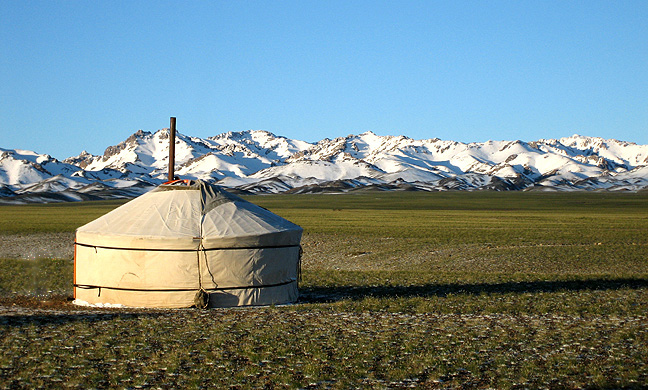
The Yurt Game

And the word of the day is:  Yurt.
GurvgerCC BY-SA 3.0

I was chatting to one of my colleagues earlier about being in a "decluttering" phase (yes, I know how futile that is when you happen to be a very cluttered person), and I said I was trying to prioritise what I would want to keep if I had to move into a yurt.

She had never heard of a yurt before, so we spent several minutes looking up pictures of various yurts from the traditional tents of nomadic Asian tribes people to the "glamping" monstrosities of today.

There's a game I've been playing as I've been trying to sort out my bookshelves, and I invite you to play a similar game in your homes:

Say you had to move from your house into a yurt.  You can make up your own reason for why, that's not the important thing.

The important thing is that your yurt doesn't have space for your bookshelves.  You have stubbornly insisted on having at least one book shelf, but that's all you get.  One.  Singular.

If you are anything like me, you probably have several bookcases scattered around your house, each at various levels of fullness.  Imagine you have to reconcile all of those books to just one shelf.

I mean every book - fiction, how-to manuals, cook books, reference books... the lot.  Whatever you can fit on one shelf of one of your current bookcase is what you get to keep.

Now, before you start thinking about your answer to this question, remember that libraries exist.  And you probably have friends with similar reading tastes.  The vast majority of books currently taking up space in your house could probably be borrowed if you really wanted to see them again.

So, what goes on the shelf?

Books that are irreplaceable.  Books where that specific copy has some deep meaning to you.  Books you use all the time or consult frequently.  Books that are so close to your heart that you can't imagine any home of yours not having this book in it...

Tell me about a no-brainer - a book you know would definitely be on that shelf.  You can put it in the comments for this post, or submit it to your social media platform of choice with the tag #yurtbooks.

It will be interesting to see what matters to you.

Friday, October 3, 2014

If Agatha Raisin went to Lochdubh...

There are many different types of crime novels, but when it comes to series of crime novels there seems to be two overarching archetypes.

One is the series that involve a detective who actually has a reason to go around solving crimes.  This person is a police officer, a sheriff, a DCI, a Kommisar... whatever the local law enforcement happens to be.  He or she is paid to find murderers, so it makes sense that they would be asking awkward questions in pursuit of a killer.

This person is usually stationed at a particular place.  Quite often this is a country town - no doubt because country towns offer a nice range of eccentric recurring characters for the author to draw on.  However, this does mean that a lot of murders occur in that country down.

Quite a lot.  An inordinate amount of murders.  So many, that these little country towns seem to be vying for the role of "crime capital of the country".

It's a wonder the eccentric locals don't all leave to find some place less murdery.  And those stay would be forgiven for getting a bit blase about it all:

"There's been a murder!"
"Oh?  Well, I suppose it has been several weeks since the last one..."

The second main archetype for crime series involves the amateur detective.  This is the person who has no good reason to go around solving crimes, they just happen to be particularly clever and always in the right place at the right time.

It doesn't seem to matter where this person goes, death is sure to follow.  Thankfully, these people are usually quite interested in crime solving and enjoy the process of finding murderers, or they would surely find the amount of death rather disturbing.

"Thank you for inviting me to your birthday party - whoops, there's a murder."
"I'm just in town for a few days visiting my - whoops, there's a murder."
"I saw this place in a holiday brochure and thought it looked like a nice - whoops, there's a murder."
"I'm afraid I can't come to your wedding on that mysterious island, even though it sounds lovely, as I want everyone to make it out alive."

I can't help but wonder what would happen if one of these murder magnets found themselves visiting one of these crime capitals.  If Miss Marple wetn to Midsomer to visit a friend, would there be a mass killing?  Would multiple people die in multiple locations under multiple sets of mysterious circumstances which may or may not be connected?

If Agatha Raisin went to Lochdubh, would anyone make it out alive?

Thursday, September 18, 2014

Some days I feel like a librarian

So, earlier today someone came to the desk and said they wanted to know where their grandfather could browse for books about medicine or books in French.

Without even looking it up, I said "the 610s for medical related books, and 840s for French literature".

She looked at me as if I was made of magic.

Just then I was doing some research for an assignment, and this is the first thing I typed into the search box:

((non-native* OR "non native") w/3 speaker*) AND (english w/3 language) AND (textbook* OR "text books" OR text-book* OR (course w/3 material*))

The first thing.

As in, I didn't even try to go to the guided search options, or start with a couple of words and see what happened - I just went straight for a search string involving several layers of brackets, multiple truncation and phrase searchers and half a dozen proximity searches.

I am a librarian.  This is how I roll.

Tuesday, September 2, 2014

Lecturers should do their own assignments

The more I re-engage with education as a student, the more I realise lecturers really need to stop marking assignments until they've actually tried doing those assignments themselves.

I recently had an assignment (an annotated bibliography) graded and given back to me, and for pretty much everyone of my lecturer's comments I had the following response1:

"Yes, I know, I thought of that, too - but there was this word limit, you see, and I couldn't fit that in without leaving something else out."

I played it out fairly evenly across the board - I left some things out of one entry and left different things out of another.  She noticed every single oversight.

I have a feeling that, had she had to do that assignment within those limitations, she would have missed out on important pieces of information as well.

But, as she was marking the assignment, not writing it, she was in a position to see the limitations in my answer, rather than the limitations imposed by the question.

At least the question was a reasonable assessment task to begin with.

At the reference desk of an academic library, I often see students come for help trying to answer really, really stupid assignment questions.  A surprisingly large part of my job involves helping students compensate for bad assessment design.

There should be a rule somewhere that states a lecturer cannot set an assignment for students until after he or she has satisfactorily completed it him/herself.


1. Not that I actually "responded".  Giving feedback on an assessment piece or its mark isn't done - although I'm sure there's something to be gained from it.

Friday, August 29, 2014

The Professor

For nine and a half hours (not consecutive), I have been listening to James Wilby read Charlotte Bronte’s first novel, The Professor, and I think I can safely sum it up in one word:

Interminable.

That book could easily be abridged.  It should have been abridged.  It wants for nothing more than a good abridgement.

Well, a good abridgement and a character who was less of an annoying jerk.

At several points during the novel, Wilby’s narration and the fact that it was a CD in my car stereo where the only things stopping me from hurling the book across the room in a fit of annoyance.

For those of you who thought Charlotte Bronte only wrote one novel, the story actually goes like this:

The Bronte sisters, having spent most of their childhood writing poetry and short stories to keep themselves amused, decided to try their hands at writing novels.  They formed their own private writing circle and worked on three novels - which they intended to publish at the same time under the gender-ambiguous pseudonyms of Currer, Acton and Ellis Bell.

Charlotte (Currer) wrote The Professor, Acton (Anne) wrote Agnes Grey and Ellis (Emily) wrote Wuthering Heights.  You may have heard of the last one.

Now, Anne and Emily’s books were both accepted for publication, but The Professor was rejected.  Probably on the grounds it of being, by turns, boring and irritating.

I just want to point something out here – Agnes Grey was accepted for publication, but The Professor wasn’t.  Agnes Grey is a romance novel in which nothing happens.  A governess puts up with children nobody likes while pining after a man who barely looks at her.  The book is roughly three-parts “my goodness, rich people’s children are obnoxious” and five parts “oh, if only he would look at me”.  Right at the end our patience is rewarded with the following exchange:

“So you do love me, then?”
“Yes.”

This book is, it must be said, kind of boring.  It’s still miles better than The Professor.

Charlotte then went on to write Jane Eyre, which you may have heard of.  That book was a roaring success – although, in hindsight, it could be regarded as Agnes Grey on spooky-pants steroids.  She also wrote Shirley (which is interesting) and Villette (which is a brilliant book, even if it has a stupid ending).  Anne went on to write The Tenant of Wildfell Hall (which is less famous than anything her sisters wrote, but more famous than her other novel).  Emily went on to die before writing anything else.

The Professor was never published in Charlotte’s life-time, and I can see why.  It’s terrible.  It was so terrible that she could never convince anyone to publish it, even though her other books made her a well-loved and respected novelist.

Okay, granted, it's not "my goodness, my mental faculties are damaged after reading this book" kind of terrible - and a Bronte completist probably shouldn't avoid it - but it's really Not Very Good.  Anyone who had the misfortune to read this book before any of her others would probably assume she was a pretty rubbish author and never read anything else by her.

It was the first full-length novel she wrote, and it appears someone told her that the trick for writing a novel (as opposed to short stories and novellas) to fill it with pointless drivel.

The first-person narration by William Crimsworth features large sections of the character yammering on endlessly about such subjects as the moon, the misery of old maids, the character of people with big foreheads and the two-facedness of Catholics.

Apart from the fact that he just seems to be talking trash for no reason other than padding out the book, the diatribes are also largely offensive as it becomes quite clear that our Mr Crimsworth is an egotistical bigot.

He is quite unpleasant, and Wilby did well to make him sound like someone not-entirely-terrible.  This is the kind of man you would meet at a party, think was a reasonably nice guy for the first few minutes, but then come to dislike the longer you listened to him talk.  At the end of the party you would probably never voluntarily seek out his company – and may even try to avoid him.

Crimsworth has a low opinion of pretty much everyone who doesn’t fit into his ideal of upper-middle-class English Protestantism.  Are you French?  You are loose of morals.  Are you Catholic?  You are a conniving, inveterate liar.  Are you Flemish?  You’re an idiot.  Are you a woman?  Your faults – whatever they may be, are somehow much, much worse than those of your male brethren.

The man is racist - that's the only way you could describe him.  And to make things weirder, he takes his racism out on Flemish people.  I dread to think what he would have said if he came in contact with a Moor.

I found myself pitying the woman who had the misfortune to be his ideal woman.  The way he spoke about her – the way he talked about how she “grew” under his “stern” tutelage…

It was just a little bit creepy.  I really hoped she would run away with his best friend, but she didn’t.  Instead they lived happily ever after – with his wife continuing to call him “monsieur” for the rest of their married lives (supposedly because she couldn’t pronounce “William” comfortably).

Charlotte, I know you’re dead, so this advice won’t do you any good, but – really, girl, you need to stop idolising Byronic jerks.  And grow a bit of self-esteem, will you?


Newest post

The Western Novella

On my recent flights to and from Brisbane, I finally got around to reading a Cleveland Western novella I've apparently had in my handbag...

Popular posts